|
May 2018,
MARIETTA, GA ~
What's the Difference and Why Does It Matter?
Average Change Rates
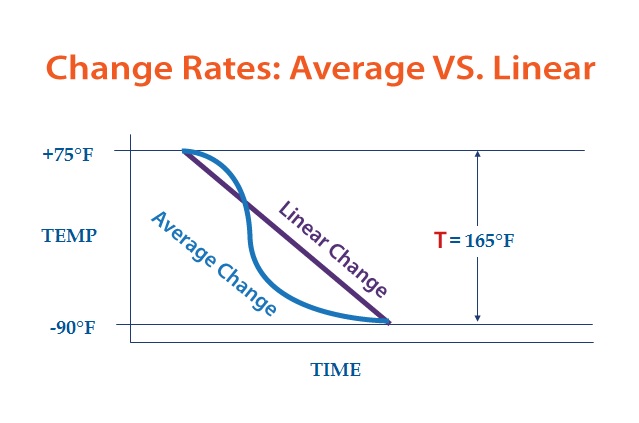
An average change rate might very be fast during the initial transition and then become slower as temperature gets colder and the compressor capacity is much smaller.
Average Change Rates are calculated on the total time of transition from cold / hot or hot / cold and divides the temperature change by minutes taken to achieve it.
Linear Change Rates
Linear change rates are accomplished by holding back refrigeration capacity early in the ramp and overpowering the system with very high capacity late in the ramp, i.e. a 1 HP system used for average change rates might need 5 HP for linear change rates over the same temperature range. A linear transition changes the same degree/per minute across the entire range.
Why Does It Matter?
Certain test protocols may require linear change rates and others may not. One of the biggest factors in being able to achieve linear rates is the chamber specifications. Linear rates require higher performance systems, specific design requirements and consequently higher cost.
The most common is an average change rate, but be sure to ask and clarify the change rate with your customer. There is a big difference in design, performance and price for linear temperature change rate requirements.
For more information on CSZ's Environmental Test Chambers &
Testing Services, please
click here.
| 
