|
MARIETTA, GA – 05/2012
- Kistler (www.kistler.com), a worldwide supplier of precision sensors, systems and instrumentation for the dynamic measurement of pressure, force, torque and acceleration, has introduced its K-Beam® high-sensitivity, low-noise MEMS capacitive accelerometer family. The K-Beam® family is designed to support single axis and triaxial measurement requirements within automotive, aerospace, civil engineering, OEM, R&D and in-laboratory test applications, particularly those in which the use of an instrument-grade accelerometer for high-precision, low-frequency measurements is required.
Type 8315A
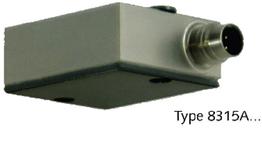 Type 8315A is a high sensitivity, low noise, single axis accelerometer family which measures acceleration and/or low-frequency vibration in the primary sensing axis. The accelerometer features include: Type 8315A is a high sensitivity, low noise, single axis accelerometer family which measures acceleration and/or low-frequency vibration in the primary sensing axis. The accelerometer features include:
-
Measuring ranges: �±2g, ±10g, ±30g, ±50g, ±100g, ±200g
-
Frequency response: 0 ... 1000 Hz (5 %) (except ±2g)
-
Bipolar �±4 V, single ended 2.5 V �±2 V and ±8 V differential accelerometer output options
-
Operating temperature –65 … 250 °F
-
Low noise
-
Excellent thermal stability
-
1 x 0.85 in. footprint
-
Wide supply voltage range, 6 … 50 VDC
-
6000 gpk shock rated
-
Conforming to CE
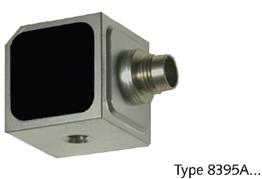 Type 8395A Type 8395A
Type 8395A is a high sensitivity, low noise triaxial accelerometer which simultaneously measures acceleration and/or low-frequency vibration in three mutually perpendicular axes (x, y, z). The accelerometer features include:
-
Measuring ranges: �±2g, ±10g, ±30g, ±50g, ±100g, ±200g
-
Frequency response: 0 ... 1000 Hz (5 %) (except ±2g)
-
Bipolar �±4 V accelerometer output
-
Operating temperature –65 … 250 °F
-
Low noise
-
Excellent thermal stability
-
Small Hermetic cube, 30 grams mass
-
Wide supply voltage range, 6 … 50 VDC
-
6000 gpk shock rated
-
Conforming to CE
Applications
The 8315A and 8395A are instrument grade, single axis and triaxial accelerometers. As such, they are well suited for a wide variety of R&D and OEM applications requiring precision measurements and packaging designed for demanding application and handling needs. In particular, the sensor design is optimized for low frequency applications common to Aviation/Aerospace, Automotive, Civil Engineering Structures, Seismic and other R&D studies. In particular, Aviation/Aerospace ground and flight testing often evaluates dynamics and structural vibration to assess performance parameters, reliability and integrity. Automotive laboratory and road testing often evaluates system parameters such as vehicle ride, dynamics and structural analysis to assess performance parameters, reliability and durability. Civil engineering structures such as bridges often are evaluated for structural response to assess the integrity of the bridge to ensure safety. Seismic ground and structural testing is often performed to measure the effect of earthquakes and other natural phenomena. Other R&D studies include human motion studies, robotics, and platform motion control systems for example./p>
|

